

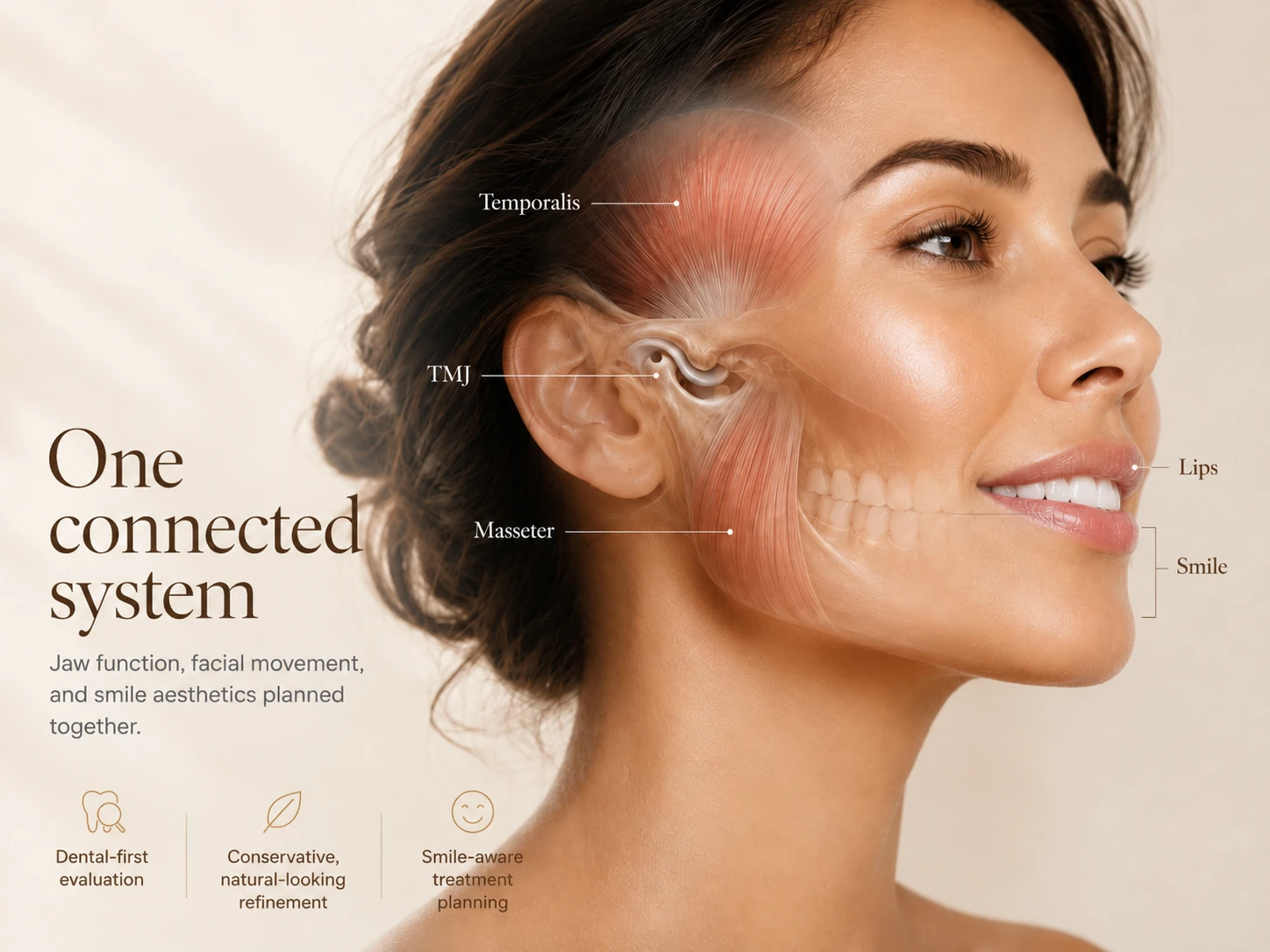
A nightguard may be enough when the main, clearly defined job is to protect teeth or restorations from grinding and clenching forces, the appliance fits comfortably, and follow-up shows that the protection plan is working. It is not a complete answer when pain, limited opening, locking, a changing bite, repeated fractures, persistent headaches, or an appliance that makes symptoms worse suggests a broader muscle, joint, dental, sleep, or medical question. The most useful principle is simple: the appliance is not the diagnosis.
Hear from Dr. Nana Dickson
Jaw Pain: 5 Common Causes Your Dentist Checks
Sore, tight or clicking jaw? Learn five possible causes your dentist may consider, and why the cause matters before choosing treatment.
Explore this video and related questionsThe short answer: protection and diagnosis are different jobs
Bruxism describes jaw-muscle activity during sleep or wakefulness. It can include grinding, sustained tooth contact, clenching, or bracing the jaw. Current international consensus treats sleep and awake bruxism as related but distinct patterns, not as a single disease with one universal treatment.
That distinction matters because a nightguard is a tool. Its job may be to separate the teeth, protect enamel and restorations, and sometimes support symptom management. It cannot, by itself, tell whether discomfort is coming from a tooth, a chewing muscle, the jaw joint, a headache condition, a sleep-related problem, a medication effect, or another source.
Many mild cases of bruxism do not require active treatment. When damage, pain, fatigue, or functional change is present, the next step should be based on the finding that matters most, not simply on the fact that someone grinds or clenches.
A three-job framework for a better decision
Most nightguard conversations become clearer when the patient and dentist separate three jobs: protect what is vulnerable, understand the pattern, and plan the least invasive next step. One patient may need only the first job. Another may need all three.
| Job | Question to answer | What success looks like |
|---|---|---|
| Protect | What is at risk from current force, such as enamel, a cracked tooth, veneers, crowns, implants, bonding, or sensitive areas? | The appliance fits, can be worn consistently, protects the intended surfaces, and is monitored for wear or change. |
| Understand | Is the important pattern awake clenching, sleep grinding, muscle pain, joint symptoms, tooth pain, restorative overload, or a combination? | The history and examination explain what is known, what remains uncertain, and whether another dental or medical evaluation is useful. |
| Plan | What is the most conservative step that addresses the actual finding without promising more than it can deliver? | The patient understands the guard's job, alternatives, monitoring plan, and the finding that would justify changing course. |
When a nightguard may be enough
A nightguard may be a reasonable primary step when the history and examination support a straightforward protection goal and no symptom suggests that a different problem is being overlooked. Examples include visible wear, a history of chipping, vulnerable restorations, or sleep grinding reported by a partner, provided the dentist has examined the teeth, muscles, joints, and current bite context.
Enough does not mean permanent or unsupervised. The dentist still needs to confirm that the appliance fits the intended arch, contacts are acceptable, the patient can tolerate it, and follow-up does not reveal worsening pain, bite change, unexpected wear, or continued damage. An appliance can succeed at protection even if it does not eliminate every grinding event.
- The main goal is clearly defined as protecting teeth or restorations.
- There is no persistent or worsening jaw pain, locking, limited opening, or painful joint noise.
- No unresolved tooth, gum, restoration, or bite problem is mimicking a muscle or joint symptom.
- The appliance feels stable and comfortable enough to use as directed.
- The follow-up plan checks the guard, tooth surfaces, restorations, symptoms, and any bite change.
When a broader TMJ or TMD evaluation adds value
TMDs are a group of more than 30 conditions involving the jaw joints, chewing muscles, and related structures. A nightguard should not become a shortcut around diagnosis when the symptom pattern is more complex than tooth protection.
Painless clicking by itself is common and often does not require treatment. Painful clicking, limited movement, locking, jaw stiffness, pain that spreads into the face or neck, or a change in how the teeth fit together deserves a more deliberate evaluation. Persistent morning jaw fatigue or headaches can also justify a broader conversation, but neither symptom proves bruxism or TMD on its own.
- Jaw pain, facial pain, or muscle fatigue continues despite consistent appliance use.
- The jaw locks, opening becomes limited, or movement changes noticeably.
- Joint sounds are painful or accompanied by loss of function.
- The bite feels newly different, especially if the change is sudden or progressive.
- Teeth, bonding, veneers, crowns, or the guard continue to chip, fracture, or wear unexpectedly.
- The appliance increases pain, creates new pressure, or no longer seats as it did.
- The symptom story overlaps with sleep concerns, medication changes, headaches, injury, or another health condition that may need coordinated care.
What Allegra Dental Center evaluates before recommending the tool
At Allegra Dental Center, a bite and TMJ conversation begins with the patient's pattern: where discomfort occurs, when it appears, what makes it better or worse, whether it affects chewing or opening, and whether the symptoms are changing. The examination can then connect that story with the teeth, restorations, wear, chewing muscles, joints, jaw movement, and bite contacts.
Tekscan T-Scan digital bite analysis may be used when timing and relative-force information can clarify a specific clinical question. It can show when recorded contacts occur and how relative force is distributed across the bite. It does not independently diagnose TMD, prove that the bite caused pain, or measure exact pounds of force on each tooth.
The point of gathering more information is not to make treatment more complicated. It is to avoid asking one appliance to solve several different problems without knowing which problem matters most.
A custom guard still needs a specific design and follow-up plan
Nightguard, bite splint, stabilization appliance, and occlusal appliance are often used as overlapping terms, but appliances can differ in material, thickness, coverage, arch, contact design, and intended job. A device made for tooth protection is not automatically the same as an appliance used within a specific TMD management plan.
Fit and behavior matter. A guard that is painful, unstable, damaged, or changing how the teeth meet should be reviewed rather than endured. The National Institute of Dental and Craniofacial Research advises that an intraoral appliance proposed for TMD should not be designed to permanently change the bite and should be stopped and reviewed if it causes pain.
Over-the-counter options may seem like a lower-cost test, but fit, coverage, and the original diagnosis still matter. A low purchase price does not answer whether the device is appropriate for a painful joint, a vulnerable restoration, a changing bite, or significant tooth wear.
Bruxism is not one behavior with one cause
Awake bruxism and sleep bruxism happen in different states and may call for different management. Daytime sustained tooth contact or jaw bracing may be addressed partly through awareness, resting-jaw habits, behavior change, and management of relevant stress responses. Sleep bruxism cannot be managed simply by reminding yourself not to clench while asleep.
Medical history belongs in the conversation. NIDCR notes that alcohol, caffeine, smoking, psychosocial factors, and certain medications may contribute to bruxism in some people. A sleep study may be considered when the history suggests a sleep-related disorder, but it is not a routine requirement for every patient who wears a guard.
This is also why the word cause should be used carefully. An association does not prove that one factor caused a patient's grinding, pain, or tooth damage. The evaluation should identify useful next questions without turning a complex pattern into an unsupported certainty.
Where self-care, physical therapy, TMJ Botox, and referral fit
A nightguard is one possible part of a broader plan. Depending on the finding, a conservative plan may also include reducing awake clenching or gum chewing, short-term self-care, guided exercises, physical therapy, behavioral support, restorative care, sleep or medical evaluation, or referral for persistent or complex pain.
TMJ Botox may be discussed for selected muscle-related concerns, but it is not a universal bruxism treatment and does not physically protect teeth or restorations. Botulinum toxin use for TMD is off label, evidence is mixed, and the intended benefit, limitations, alternatives, safety, and follow-up should be defined for the individual patient.
The best plan is not the one with the most treatments. It is the smallest reversible plan that addresses the current finding, protects what matters, and creates a clear reason for follow-up or referral.
Cost and insurance: compare the complete job, not only the appliance price
The cost of a guard can vary with the type of appliance, records, materials, laboratory process, adjustments, and follow-up. Insurance coverage also varies by plan, diagnosis, frequency limits, network rules, and whether an appliance is considered medically or dentally necessary. An estimate is not a guarantee of payment.
When comparing options, ask what the fee includes, how fit and contacts will be checked, what happens if the device is uncomfortable, how repairs or replacement are handled, and when the result will be reassessed. The less expensive option is responsible when it can perform the same defined job safely. It is not equivalent when it removes the diagnosis, monitoring, or adjustment that the case needs.
What happens if you wait?
Waiting is not automatically dangerous. Mild bruxism may not need treatment, painless jaw sounds are common, and many jaw muscle or joint symptoms improve with simple care. Monitoring can be a responsible decision when the findings are stable and the patient understands what should trigger another visit.
Waiting deserves more caution when damage or function is changing. Progressive tooth wear, cracks, repeated restoration failure, persistent pain, limited opening, locking, or a new bite change can narrow conservative options or allow a different condition to remain unrecognized. The dentist should explain what appears stable, what is at risk, and what evidence would change the recommendation.
Make a short note to bring to the evaluation
You can describe a change without deciding what caused it. Use these prompts to organize what you notice, then ask the dentist to connect those observations with the examination. Leave anything you do not know unanswered.
Keep this note for your own consultation. You do not need to enter personal health information into a website form to use it.
| Before the visit: what I notice | During the visit: what I want explained |
|---|---|
| Where I feel discomfort, when it happens, and whether chewing or opening has changed. | What does the examination suggest, and what remains uncertain? Does another dental or medical evaluation belong in the plan? |
| Any tooth, restoration or appliance that has worn, chipped, broken or started to feel different. | What specifically needs protection? Is a guard meant to protect teeth, help manage symptoms, or do both? |
| Whether I notice clenching while awake, have been told I grind during sleep, or have an existing guard. | How do those observations fit with the teeth, muscles and joints? Which observations do not establish a diagnosis on their own? |
| What my current appliance feels like, including pain, pressure, instability or a change in how my teeth meet. | Does the appliance need review? What should make me stop wearing it and contact the office? |
| My questions about cost, fit, follow-up, alternatives and what happens if the first approach does not help. | What is included, when will the plan be reassessed, and what finding would change the next step? |
Leave knowing the job, the unanswered question and the review point
You do not need to decide in advance that you need a guard, TMJ treatment, Botox, or a bite adjustment. Bring the pattern, the appliance if you already have one, and the questions that matter to you. The evaluation should define what needs protection, what needs explanation, and what can reasonably be monitored.
For some patients, that leads to a well-defined nightguard plan. For others, it leads to a broader TMJ evaluation or coordinated care. Either result is useful when it replaces a generic solution with a decision that fits the patient.
Ask the dentist to help you finish three sentences: “The purpose of the proposed step is ___.” “It will not answer ___, so the plan for that question is ___.” “The finding that should bring me back or change the plan is ___.” These are conversation prompts, not a way to choose a diagnosis yourself.
For a tooth-protection recommendation, the first answer should identify the teeth or restorations being protected. A comfortable appliance or less visible wear does not, by itself, establish why a headache or jaw symptom occurs. Ask how symptoms and function will be reviewed separately from the guard’s fit and wear.
For a broader evaluation, ask which question needs more explanation before another appliance is chosen. A discussion of muscle, joint, dental, sleep or medical possibilities does not mean you need every test or treatment. The next step should answer a specific question from your history and examination.
If monitoring is recommended, ask what appears stable, when it will be checked and what change should prompt another visit. Monitoring is a plan to review a defined finding, not an instruction to ignore worsening symptoms.
Watch the decision guide
A Nightguard Is Not the Diagnosis
A concise Allegra Dental Center guide to the three separate jobs a nightguard conversation should address: protect what is vulnerable, understand the pattern, and plan the smallest appropriate next step.
Read the video transcript
If you wake with jaw fatigue, keep chipping dental work, or have been told you grind your teeth, a nightguard may protect what is vulnerable. But protection and diagnosis are different jobs.
A useful plan answers three questions.
First, what needs protection: enamel, a cracked tooth, a crown, veneers, or another restoration?
Second, what pattern needs understanding: sleep grinding, daytime clenching, muscle pain, joint symptoms, or a combination?
Third, what is the smallest appropriate next step?
A guard may be enough when the goal is clear, it fits comfortably, and follow-up shows the plan is working. Persistent pain, locking, limited opening, a changing bite, or continued fractures deserves a broader evaluation.
At Allegra Dental Center, Dr. Nana Dickson connects symptoms, muscles, joints, tooth wear, restorations, and bite contacts. T-Scan may add timing and relative-force data when useful, but it does not diagnose TMD on its own.
Schedule a bite and TMJ evaluation to learn whether protection is enough or a broader plan could help.
Common questions
Questions patients ask before deciding
Does a nightguard stop bruxism?
Not necessarily. A nightguard separates the teeth, protects vulnerable surfaces, and may reduce muscle activity in some people. It does not prove that grinding or clenching has stopped, and it should not be presented as a universal cure.
Can a nightguard help TMJ pain?
It may help some patients, but evidence for TMD pain improvement is limited and TMDs include many different conditions. The diagnosis, appliance design, symptoms, and response all matter. Stop using an appliance and contact the dentist if it causes new or worsening pain.
What is the difference between TMJ and TMD?
TMJ refers to the temporomandibular joint itself. TMD refers to a group of disorders that can affect the jaw joints, chewing muscles, and related structures. Patients often use TMJ to describe the condition, but TMD is the more precise clinical term.
Does clicking mean I need treatment?
Not by itself. Painless clicking or popping is common and often does not require treatment. Painful sounds, locking, limited opening, or a change in function deserve evaluation.
Should I use an over-the-counter nightguard first?
A lower-cost device does not answer whether the symptom is dental, muscular, joint-related, sleep-related, or medical. Fit and coverage matter, especially with pain, a changing bite, significant wear, or vulnerable restorations. Ask a dentist to define the job before using an appliance as a diagnostic test.
Can a nightguard make jaw pain worse?
It can be uncomfortable or aggravate symptoms in some situations. A guard that causes pain, pressure, a bite change, or new symptoms should be stopped and reviewed rather than worn through the problem.
Do morning headaches prove that I grind my teeth?
No. Morning headaches can occur alongside bruxism or TMD symptoms, but they are not specific enough to establish a cause. Timing, muscle tenderness, tooth wear, sleep history, medications, and other medical possibilities may need review.
Does Allegra Dental Center use T-Scan for every nightguard?
No. Allegra Dental Center uses T-Scan selectively when bite timing and relative-force information is likely to clarify a clinical question, influence planning, or help verify a result. It is not a stand-alone TMD or bruxism diagnostic test.
Will insurance cover a custom nightguard or TMJ evaluation?
Coverage varies by plan, diagnosis, frequency limits, network rules, and the service provided. Ask for an estimate and verify benefits with the plan. An estimate is not a guarantee of payment.
When should I seek a TMJ evaluation instead of replacing my guard?
Seek an evaluation when pain persists or worsens, the jaw locks or opens less, joint sounds are painful, the bite changes, teeth or restorations continue to fail, or the current appliance creates new symptoms. Those findings may require a broader diagnosis rather than another version of the same device.
Sources and further reading
- Bruxism: Causes, Diagnosis, and TreatmentNational Institute of Dental and Craniofacial Research
- Temporomandibular Disorders: Symptoms, Diagnosis, and TreatmentNational Institute of Dental and Craniofacial Research
- Updating the Bruxism Definitions: Report of an International Consensus MeetingJournal of Oral Rehabilitation
- Executive Summary of the Diagnostic Criteria for Temporomandibular DisordersJournal of the American Dental Association
- Occlusal Interventions for Managing Temporomandibular DisordersCochrane Database of Systematic Reviews
- Digital Occlusal AnalysisTekscan