What is masseter Botox, and can it help jaw tension?
Masseter Botox refers to botulinum toxin injections considered for the masseter muscles at the sides of the jaw. It may be discussed for selected patients when excessive jaw-muscle activity contributes to tension, clenching-related soreness, or TMD symptoms. It is not a cure for every TMJ concern, and an evaluation is needed first.
Is Botox FDA-approved for TMJ or TMD?
Botulinum toxin Type A is FDA-approved for some medical and cosmetic uses, but it is not FDA-approved specifically for TMD. If it is discussed for jaw symptoms, Allegra Dental Center reviews diagnosis, risks, alternatives, and realistic expectations first.
Is masseter Botox the same as TMJ Botox or jaw-slimming Botox?
The medication and muscles may overlap, but the goals are different. Jaw-focused treatment targets a documented muscular contribution to symptoms, while jaw slimming is a cosmetic objective. Allegra Dental Center evaluates and discusses those goals separately.
Why see a dentist for Botox?
A dentist brings a clinical perspective centered on the jaw, bite, teeth, lips, chewing muscles, and smile. That perspective is particularly relevant for patients considering masseter treatment, lower-face refinement, gummy-smile concerns, jaw tension, or Botox as one part of a broader cosmetic dental plan. The dental foundation should always be combined with injectable-specific training, conservative case selection, and responsible follow-up.
Are all dentists automatically qualified to provide cosmetic Botox?
No. Dental education provides relevant knowledge of craniofacial anatomy and function, but cosmetic Botox also requires procedure-specific training in assessment, pharmacology, placement, dosage, consent, risks, complication management, and follow-up. Patients should feel comfortable asking about both professional background and injectable training.
What makes Allegra Dental Center's Botox approach different?
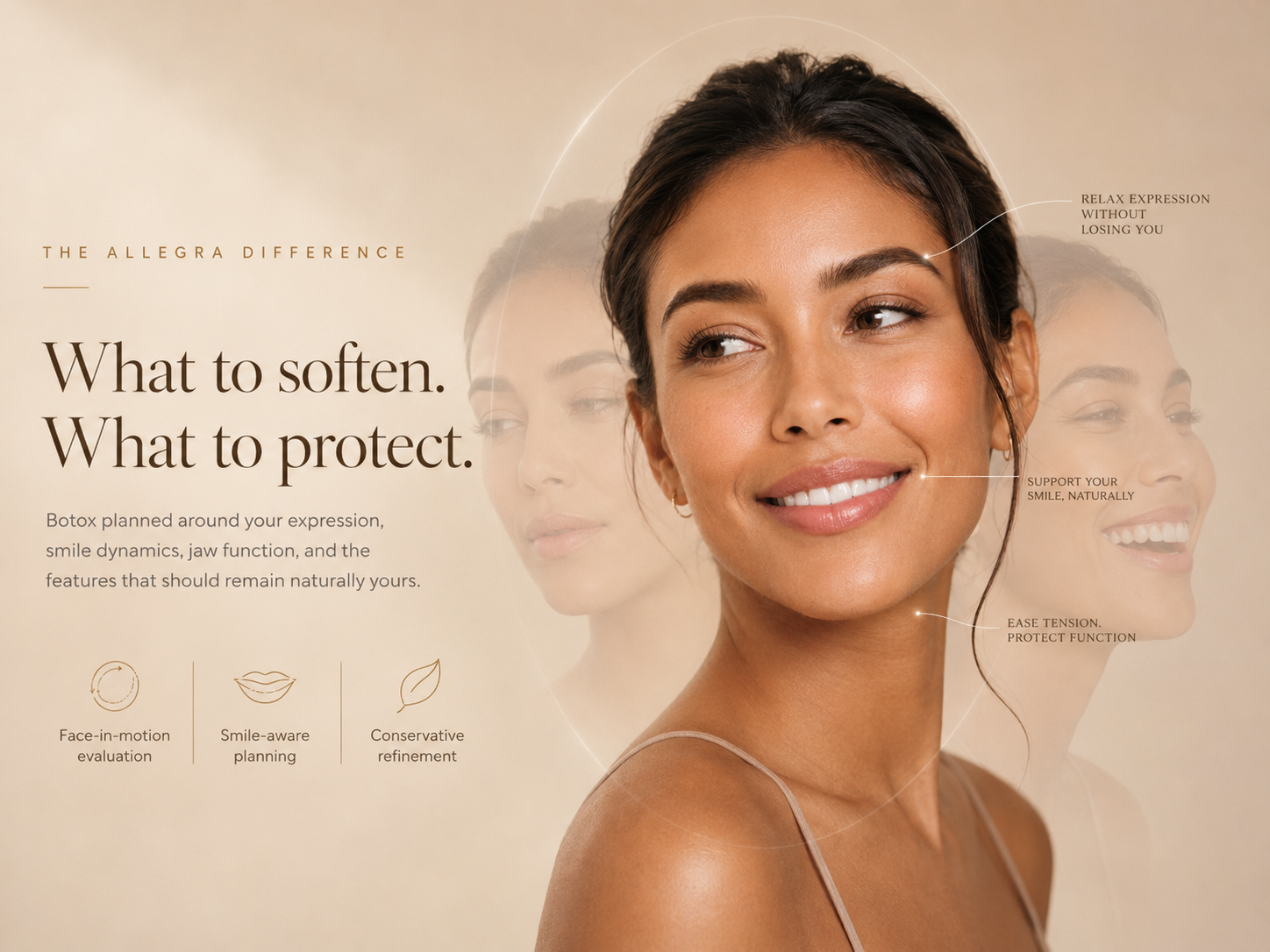
The consultation does not begin by counting lines or selecting units. It begins by understanding the patient's goal, evaluating the face in motion, considering the jaw and smile, and determining whether Botox is the right tool. When treatment is appropriate, the goal is conservative refinement that preserves natural expression.
Will Botox make me look frozen?
That is not the goal. Allegra Dental Center plans Botox conservatively so treatment can soften excess tension or expression while preserving a natural look when treatment is appropriate.
How long does Botox last?
Botox is temporary. Duration and follow-up timing vary by patient, treatment area, dose, and muscle activity. Allegra Dental Center discusses maintenance only after reviewing the treatment goal and individual response.
Does Botox for bruxism replace a nightguard?
Not necessarily. A nightguard may help protect teeth from grinding damage, while Botox may reduce selected muscle activity. Some patients may need one, both, or another approach.
Is Botox safe?
Botox is a prescription treatment and should be provided only after a proper evaluation. As with any procedure, risks and side effects are possible and should be discussed before treatment.
Can Botox be part of cosmetic dentistry?
Sometimes. Because the teeth and face are seen together, Botox may complement whitening, veneers, aligners, or smile design for selected patients, but it should fit the broader plan.