Contact sequence
Which teeth make contact first?
An early contact may influence how the rest of the bite closes or how force travels across the dental arch.

Digital bite analysis in Fairfax
T-Scan® technology by Tekscan helps Allegra Dental Center study when tooth contacts occur and how relative force is distributed, so clinically meaningful decisions can be made with more clarity and verified with more discipline.
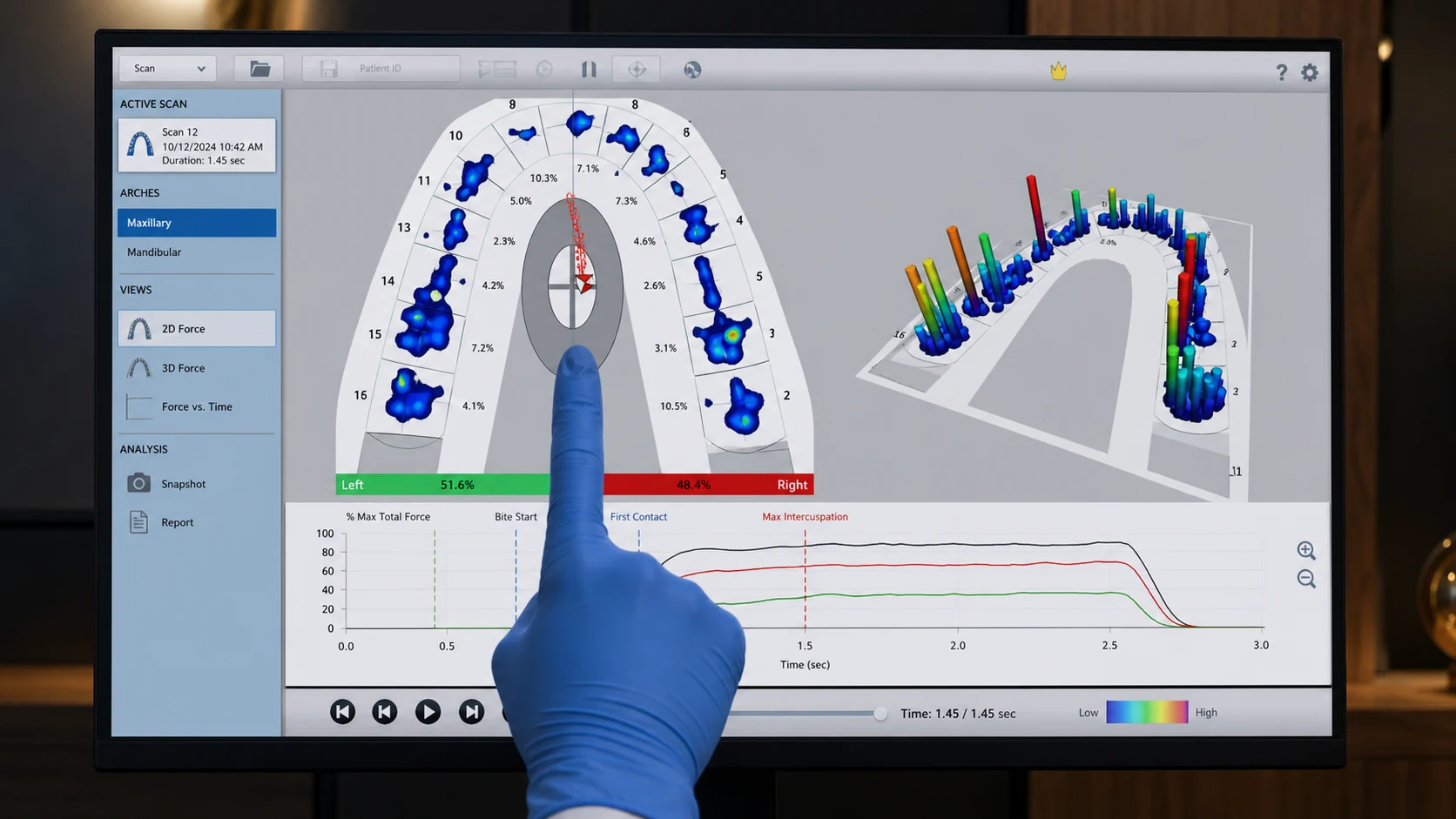
Objective data, interpreted responsibly
Most bite checks show where the teeth touch. T-Scan adds information about when contacts occur and how the recorded force is distributed relative to other contacts. Allegra Dental Center uses that information as one part of a complete evaluation, never as a replacement for examination or experienced clinical judgment.
The recording is considered alongside the teeth and gums, existing restorations, wear patterns, jaw movement, muscle and joint findings, symptoms, imaging, photographs, and the patient's goals. The aim is not to make a colorful graph look perfect. The aim is to decide whether the information is clinically meaningful.
When comfort or wear is part of the picture
Explore how tooth wear, comfort, existing dental work, bite forces, and long-term maintenance can change the planning conversation without treating this report as a diagnosis.
Five focused questions. A personal report in about one minute.
A bite is more than where teeth touch
Articulating paper remains useful for locating specific contacts. T-Scan answers a different set of questions by recording timing and relative distribution dynamically. The two tools can complement one another.
The visual is illustrative, not a patient result or a definition of a “perfect” bite.
What the recording can help us ask
Contact sequence
An early contact may influence how the rest of the bite closes or how force travels across the dental arch.
Relative distribution
Two marks can look similar on paper while carrying different proportions of the recorded contact force.
Change over time
A dynamic recording lets the dentist study the progression from first contact through closure and, when relevant, movement.
Reassessment
A recording can be repeated after a clinically indicated adjustment or treatment phase to help verify what changed.
Allegra Dental Center's clinical point of view
Not every asymmetry is disease. Not every early contact requires adjustment. Not every uncomfortable tooth is experiencing excessive bite force. A digital image is never, by itself, a reason to remove healthy enamel.
We look for findings that are
When Allegra Dental Center may use T-Scan
The exact use depends on the examination and the care being considered. T-Scan does not identify every cause of wear, discomfort, or restoration failure, and it does not justify unnecessary adjustment.
Worn edges, repeated chipping, changing bite sensations, or recurring restoration problems may justify a closer look at contact timing and force distribution.
When clinically relevant, T-Scan may help identify an early or disproportionately heavy contact as a restoration becomes part of the functioning bite.
Straighter teeth do not automatically explain how the finished bite functions. Digital contact data may add useful context during or after aligner treatment.
An appliance can fit accurately while contacts remain uneven. A recording may help the dentist evaluate whether an adjustment is appropriate.
For selected restorative or full-mouth cases, baseline bite data can provide a reference point before treatment and as the plan progresses.
When an adjustment is clinically indicated, repeating the scan can help determine whether the intended timing or distribution change occurred.
What your T-Scan experience may look like
The process is brief and noninvasive. The value is not the screen itself; it is the clearer reasoning behind what Allegra Dental Center recommends, monitors, or decides not to change.
You close or move your teeth against a thin sensor while the system records contact timing and relative force distribution.
Your dentist reviews the recording with symptoms, tooth wear, restorations, muscles, joints, imaging, and treatment goals.
If the finding is clinically meaningful, the information may guide monitoring, protection, further evaluation, or a conservative treatment decision.
When useful, a repeat recording helps show whether the intended change occurred instead of relying on appearance or assumption alone.
Where Tekscan fits within the Forma Method
T-Scan belongs inside the functional stage of planning. It can add dynamic contact information before Allegra Dental Center changes structure or refines the visible result. Beautiful dentistry should not merely photograph well; it should respect how the patient actually functions.
Explore the Forma MethodDigital bite analysis questions
No. Articulating paper helps locate where teeth contact. T-Scan records the sequence and relative distribution of contact force over time. Allegra Dental Center may use the tools together because they answer different questions.
No. Allegra Dental Center uses T-Scan selectively when the information is likely to clarify a clinical question, influence planning, or help verify a result.
No. T-Scan principally reports timing and relative force distribution. It helps show how recorded contact force is shared; it should not be described as an exact pounds-per-tooth measurement.
No. It provides tooth-contact timing and relative-force information. It does not independently diagnose a temporomandibular disorder or prove that a bite is causing jaw pain, headaches, or muscle symptoms.
No technology can guarantee longevity. T-Scan may help identify contact patterns the dentist believes deserve attention, but material, tooth condition, hygiene, disease risk, habits, technique, and trauma also matter.
Cosmetic treatment can change tooth shape, position, or contact. Evaluating function before and during care helps Allegra Dental Center plan appearance in the context of comfort, structure, and long-term maintenance.
Clinical context
Our patient explanation reflects Tekscan's description of dynamic timing and force data and current research showing that T-Scan measurements require careful interpretation. For TMJ/TMD concerns, Allegra Dental Center follows conservative diagnostic boundaries rather than treating a bite recording as a stand-alone cause.
Clarity before treatment. Verification before completion.
A functional evaluation may be appropriate if you have worn or repeatedly chipped teeth, a bite that feels different, recurring restoration problems, or plans for significant restorative, cosmetic, implant, or clear-aligner treatment.