
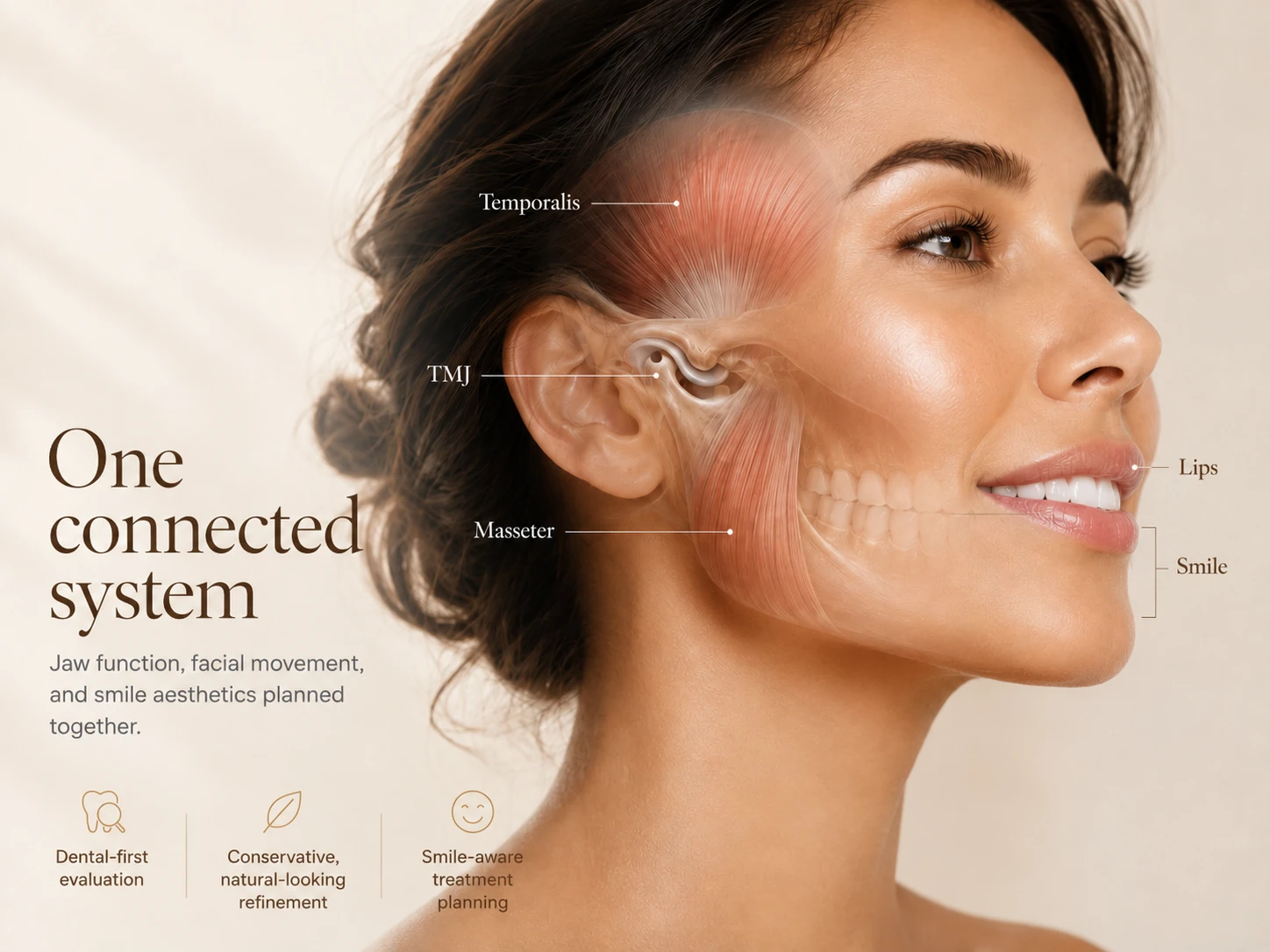
Jaw tension, clenching-related soreness, and overworked chewing muscles can make eating, sleeping, concentrating, and moving through the day less comfortable. For an appropriate patient, TMJ Botox may be a useful way to reduce excessive chewing-muscle activity as part of a broader TMD care plan. A consultation at Allegra Dental Center is designed to identify that fit, explain the potential benefit, and give you a clear path forward.
The short answer: a consultation can identify whether Botox may help
Many patients searching for masseter Botox want help with morning jaw fatigue, clenching, grinding-related soreness, temple tension, discomfort while chewing, or a feeling that the masseter muscles at the sides of the jaw never fully relax. When excessive chewing-muscle activity is an important part of the problem, TMJ Botox may be worth considering.
The consultation connects those symptoms with your health history, dental findings, jaw movement, muscle tenderness, tooth wear, and goals. This is not an obstacle to care. It is how the clinician identifies patients who may benefit and builds a treatment plan around the right problem.
TMJ Botox is a common patient search term for jaw-tension concerns, while masseter Botox names the chewing muscle patients often have in mind. TMD is the more accurate name for the group of temporomandibular disorders being evaluated. TMDs include more than 30 muscle, joint, and headache-related conditions. Because jaw and facial symptoms can have different causes, a careful evaluation protects the opportunity for useful treatment. It can support a Botox discussion when the pattern is muscle-related or direct you to another form of care when that is more likely to help.
What happens during the consultation
The visit should connect your symptoms, health history, dental findings, and goals so the recommendation is personal rather than trend-driven. It is also the time to separate a jaw-comfort concern from a cosmetic lower-face goal. The medication may be similar, but the intended benefit, treatment areas, planning, and follow-up are not interchangeable.
This reflects two Allegra Dental Center standards. The Allegra Dental Center Experience means the conversation should feel clear, personal, and unhurried. The Forma Method means the recommendation considers how the chewing muscles, jaw joints, bite, facial movement, and smile work together rather than treating one isolated feature.
- Your story: where the tension or pain is located, when it occurs, what makes it better or worse, whether it spreads, and how it affects chewing, sleep, work, exercise, or daily comfort.
- Your health history: medical conditions, medications, allergies, prior botulinum toxin treatment, swallowing or breathing problems, muscle or nerve conditions, pregnancy or breastfeeding questions, and any recent dental or facial changes.
- Your dental history: clenching or grinding, worn or chipped teeth, existing restorations, prior guards, orthodontic treatment, bite changes, injuries, and previous TMD or headache care.
- The examination: jaw opening and movement, tenderness in the chewing muscles and joints, joint sounds when they are painful or limiting, tooth wear, bite contacts, facial movement, and the areas that reproduce the concern.
- The recommendation: whether the pattern appears primarily muscular, what improvement would be meaningful to you, whether Botox may support that goal, and what follow-up or complementary care would strengthen the plan.
How diagnosis improves the chance of useful care
Jaw tension is a symptom, and identifying its main driver makes the treatment recommendation more useful. A tight or enlarged chewing muscle can be part of the picture, while joint problems, dental disease, injuries, headache disorders, sleep concerns, medication effects, and other pain conditions can overlap.
There is no single widely accepted test that diagnoses every TMD. The National Institute of Dental and Craniofacial Research describes a process built around symptom history, medical history, examination of the head, neck, face, and jaw, and imaging when the findings justify it. The clinician may also need to rule out another condition.
This process helps distinguish a muscle-related pattern that may support TMJ Botox from a joint, tooth, sleep, headache, or medical concern that needs a different path. The result is not simply more caution. It is a better chance of matching the patient with care that addresses the finding.
Who may benefit from a jaw-focused Botox discussion
A discussion may be reasonable when the examination supports a specific muscle-related concern, such as excessive chewing-muscle activity contributing to jaw fatigue, clenching-related soreness, or unwanted lower-face muscle bulk. For an appropriate patient, the treatment goal may be to reduce selected muscle activity and support greater day-to-day comfort as part of a broader plan.
Botox for TMD or jaw tension is an off-label use. The FDA explains that clinicians generally may prescribe an approved drug for an unapproved use when they judge it medically appropriate for the patient, but the FDA has not determined that the drug is safe and effective for that specific unapproved use. Evidence for TMDs overall remains limited, so the recommendation should be individualized and the intended benefit should be specific.
- The symptoms and examination point to a defined muscular concern rather than an unexplained or primarily joint-centered problem.
- The intended benefit is specific and meaningful to the patient, such as addressing excessive chewing-muscle activity that appears to contribute to fatigue or soreness.
- The patient understands why Botox is being considered, what improvement the plan will measure, and what complementary care may still be useful.
- The health history, medication review, examination, and informed-consent discussion do not identify a reason to avoid or postpone treatment.
- The plan includes follow-up and does not ignore tooth protection, sleep, stress, physical therapy, medical care, or other needs when they are relevant.
When another path may help more
A benefit-led consultation also identifies when another path is more likely to help. Botox may be a poor fit when the concern is not primarily muscular, another condition needs evaluation, or the desired result does not match what temporary muscle reduction can reasonably address.
Treatment should be postponed when the prescriber identifies a safety concern, including an infection at a proposed injection site or a known allergy to a botulinum toxin preparation or one of its ingredients.
The FDA-approved prescribing information also calls for special caution with certain muscle or nerve disorders, swallowing or breathing problems, and medications that can affect neuromuscular transmission. A patient should disclose every botulinum toxin treatment and medication rather than assuming a cosmetic or medical injection is unrelated.
Choosing a better-matched option is still active care. The goal is to improve comfort or function through the treatment pathway most likely to address the finding.
How Botox can fit into a broader care plan
TMJ Botox does not have to be an all-or-nothing choice. Depending on the diagnosis, it may be considered alongside short-term self-care, reducing clenching or gum-chewing habits, guided jaw exercises, physical therapy, behavioral support, tooth protection, sleep evaluation, or other dental or medical care.
These options have different jobs. A guard may help protect teeth but does not automatically treat every source of jaw discomfort. Physical therapy may support selected movement or muscle concerns. Botox may address selected muscle activity. A referral may add value when the pattern suggests a joint disorder, neurologic concern, headache condition, sleep-related problem, or complex persistent pain.
The National Institute of Dental and Craniofacial Research advises caution with treatments that permanently change the teeth, bite, or jaw joints when evidence is limited. A consultation should explain why a reversible step is being chosen and what finding would justify changing the plan.
The potential benefit and its limits
Botulinum toxin temporarily reduces activity in the muscles where it is placed. For a selected patient, that may support a plan aimed at excessive chewing-muscle activity and related jaw fatigue or soreness. The response can differ from one person to another, so the consultation should define the practical improvement the patient and clinician will evaluate at follow-up.
| Potential role for an appropriate patient | Important limit |
|---|---|
| Temporarily reduce selected chewing-muscle activity when the evaluation supports that goal. | Diagnose the cause of jaw pain or prove that the jaw joint is healthy. |
| Support a broader plan for selected muscle-related jaw tension. | Cure every TMD, headache, clenching pattern, or grinding-related problem. |
| Change muscle activity for a limited period. | Protect teeth and restorations from wear without a separate protection plan. |
| Offer a temporary, non-surgical option when benefits, risks, and alternatives have been reviewed. | Replace appropriate dental, medical, physical-therapy, sleep, or behavioral care. |
Comfort, appearance, safety, and follow-up
It is reasonable to ask what the injections may feel like and how treatment could affect the rest of your day. FDA prescribing information notes that localized pain, tenderness, swelling, redness, bleeding, or bruising may occur with an injection. Because jaw-focused treatment is off label and individual plans vary, the consultation should give you treatment-specific guidance about eating, exercise, return to routine, and when to contact the office rather than making a blanket promise of no downtime.
Botox works by reducing muscle activity. Local weakness in an injected muscle is part of its expected action, and nearby muscles can also be affected. For jaw-focused care, ask how the proposed placement could influence chewing strength, smile balance, or lower-face appearance, what changes are intended, and what the clinician does to protect the features and functions that should remain unchanged.
The conversation should also cover who will perform the injections, the product being used, the treatment goal, the fact that jaw-focused treatment is off label, and the planned follow-up. A responsible plan defines when response will be reassessed and what would justify repeating, adjusting, combining, or stopping treatment. No exact maintenance schedule should be promised before the patient and response are evaluated.
Botox is a prescription treatment. Its FDA-approved labeling includes a boxed warning that toxin effects can spread beyond the injection area and, in rare cases, cause serious swallowing or breathing problems. The consultation should explain which risks are relevant to you, what symptoms require urgent medical attention, and how Allegra Dental Center handles questions after treatment. The FDA advises patients to receive approved botulinum toxin products from a licensed and trained health professional using an authorized source.
- What finding suggests that excessive muscle activity is contributing to my symptoms?
- What improvement are we trying to create in comfort or function?
- What should I expect during the injections and afterward?
- Could the plan affect chewing strength, smile balance, or lower-face appearance?
- Is this use FDA-approved or off label, and what evidence supports recommending it for me?
- What alternatives or complementary care could improve the plan?
- What follow-up is planned, and how will we decide whether to repeat, adjust, or stop treatment?
How meaningful results should be evaluated
Two people can use the same words, jaw tension, while having different causes, anatomy, muscle patterns, health histories, daily habits, and treatment goals. That is why the consultation should define success personally. The relevant question may be whether chewing feels easier, morning fatigue is less disruptive, muscle soreness interferes less with the day, or another clearly stated goal has improved.
Follow-up should return to that goal and ask what changed, what did not, and what still needs attention. Less muscle tightness is not the same as treating a joint problem, and a cosmetic lower-face change is not the same as improved comfort. Clear goals help a suitable patient and clinician judge whether TMJ Botox earned a continuing role in the care plan.
When jaw tension is affecting daily life, evaluation is a constructive next step
You do not need to commit to injections before you understand the recommendation. A consultation gives you a place to ask about the working diagnosis, likely benefit, treatment experience, alternatives, safety, cost, and follow-up.
Some jaw symptoms improve with simple care, while persistent, worsening, or function-limiting concerns deserve evaluation. If jaw tension is interfering with chewing, sleep, concentration, exercise, or daily comfort, seeking a clear answer is an active step toward feeling better. The evaluation can show whether TMJ Botox may help or connect you with another useful path.
Watch the decision guide
Could TMJ Botox Help Your Jaw Tension?
A warm, concise guide to how Allegra Dental Center evaluates jaw tension, muscle-related candidacy, potential benefit, alternatives, and follow-up before treatment.
Read the video transcript
Jaw tension, clenching-related soreness, and jaw fatigue can interfere with chewing, sleep, and daily comfort. For an appropriate patient, TMJ Botox may be a useful way to reduce excessive chewing-muscle activity as part of a broader TMD care plan.
A thoughtful consultation is how Allegra Dental Center identifies that fit. It reviews where symptoms occur, how they affect daily life, health and dental history, jaw movement, chewing muscles, jaw joints, and tooth wear.
When the findings support a muscle-related concern, the clinician can explain the potential benefit, comfort, safety, alternatives, and follow-up before treatment. Botox for TMD or jaw tension is an off-label use, and individual results vary.
If jaw tension, clenching-related soreness, or jaw fatigue is affecting your comfort, schedule an evaluation with Allegra Dental Center to learn whether TMJ Botox may be a reasonable option for you.
Common questions
Questions patients ask before deciding
Does a TMJ Botox consultation mean I will receive injections that day?
Not automatically. The consultation is designed to identify whether excessive chewing-muscle activity is contributing and whether TMJ Botox may offer a meaningful benefit. If you are an appropriate candidate and you understand the plan, treatment may be discussed. If another path is more likely to help, Allegra Dental Center should explain that next step clearly.
Is Botox FDA-approved for TMJ or TMD?
No. Botox is FDA-approved for several medical and cosmetic uses, but TMD is not one of the listed indications. A clinician may discuss off-label use, which should include a clear explanation of the evidence, risks, alternatives, and uncertainty.
Can Botox cure TMJ problems?
Botox is not a cure for every TMJ or TMD concern because these conditions can involve different muscles, joints, and headache patterns. For an appropriate patient with a defined muscle-related concern, it may still be a useful part of a plan to reduce selected chewing-muscle activity and support greater comfort.
Will Botox stop grinding or protect my teeth?
Not necessarily. It may reduce selected muscle activity, but it does not prove that grinding has stopped and does not physically protect teeth or restorations. A separate protection or treatment plan may still be needed.
How long will the result last?
Botox is temporary, but jaw-focused treatment is off label and an exact duration should not be promised before evaluation. Response varies with the patient, treatment purpose, anatomy, muscle activity, and clinical plan. Follow-up should determine whether the result supports repeating, adjusting, combining, or stopping treatment.
Does insurance cover Botox for jaw tension?
Coverage varies by plan and proposed use, and off-label treatment may affect coverage. Ask for the expected fee and confirm benefits directly before treatment. An estimate is not a guarantee of payment.
What if Botox is not the right option?
The consultation should still move your care forward. Depending on the finding, Allegra Dental Center may discuss self-care, physical therapy, tooth protection, sleep evaluation, treatment of another dental concern, medical or specialty referral, or monitoring. The right alternative is the one most likely to address the actual source of the problem.
Do TMJ Botox injections hurt, and should I expect downtime?
Injection-site discomfort, tenderness, swelling, redness, bleeding, or bruising can occur. Jaw-focused treatment is off label and individual plans vary, so the consultation should explain what to expect during treatment, any guidance for eating or exercise, how quickly you can return to routine, and when to contact Allegra Dental Center. Avoid relying on a universal promise of no discomfort or no downtime.
Could masseter or TMJ Botox affect chewing, my smile, or the shape of my lower face?
Botox intentionally reduces activity in selected muscles, and nearby muscles can also be affected. The consultation should define whether the goal is jaw comfort, muscle bulk, or both and explain how placement could influence chewing strength, smile balance, or lower-face appearance. The plan should protect the functions and features that are not intended to change.
How are follow-up and repeat treatment decided?
The plan should identify the original goal and when it will be reassessed. At follow-up, the patient and clinician can compare what improved, what did not, and whether complementary care is still needed. That evidence should guide whether treatment is repeated, adjusted, combined with another option, or stopped rather than assuming a fixed maintenance schedule.
Sources and further reading
- Temporomandibular Disorders: Symptoms, Diagnosis, and TreatmentNational Institute of Dental and Craniofacial Research
- Summary of Treatment for Temporomandibular DisordersNational Institute of Dental and Craniofacial Research
- Understanding Unapproved Use of Approved DrugsU.S. Food and Drug Administration
- BOTOX Cosmetic Prescribing Information, Revised October 2024U.S. Food and Drug Administration
- FDA Warning on Unapproved and Misbranded Botulinum Toxin ProductsU.S. Food and Drug Administration